
At Factory2Key , we regularly analyse housing and construction data to understand what’s really driving affordability, supply, and long-term housing outcomes across Australia.
Australia’s housing challenge isn’t coming from a lack of awareness. It’s coming from a lack of delivery.
The latest housing construction and dwelling completion data paints a familiar picture: some green shoots on commencements, a stubborn bottleneck on completions, and a widening gap between what Australia needs and what the industry can realistically supply under current building models.
Let’s unpack what the charts are really telling us — and why incremental change won’t solve a structural problem.
The Big Picture: Activity Is Rising, Output Is Not
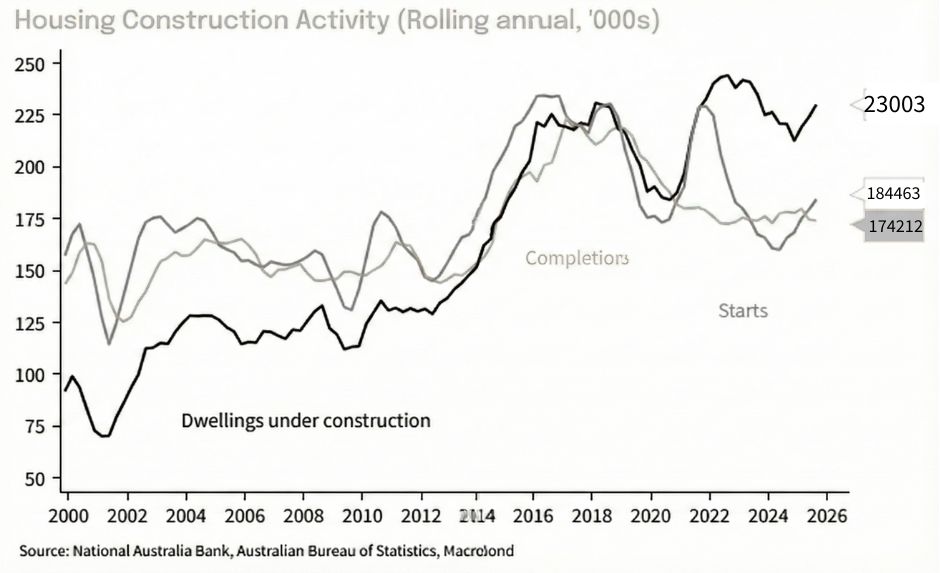
The rolling annual data on housing construction activity shows three key trends playing out at once:
- Dwelling commencements have lifted over the past year, running at roughly 184,000 dwellings per annum.
- Completions remain stuck closer to 170,000 dwellings per annum.
- The pipeline of dwellings under construction is elevated, sitting around 230,000 homes — well above pre-pandemic norms.
At first glance, a growing construction pipeline sounds positive. In reality, it’s a warning light.
A larger pipeline combined with flat completions tells us that homes are taking longer to finish. Labour shortages, trade sequencing issues, weather disruptions, financing delays, and fragmented project management are all stretching build times well beyond historical averages.
The result? Even when starts improve, the system simply can’t convert activity into completed homes fast enough.
Completion Times: The Hidden Constraint
Before the pandemic, detached homes typically took 6–9 months to complete. Medium and high-density projects weren’t much longer.
Today, completion times are materially longer across all dwelling types.
This matters because Australia doesn’t suffer from a planning problem alone — it suffers from a throughput problem.
You can approve more projects. You can stimulate demand. You can encourage commencements.
But if the industry’s delivery engine is constrained, the end result doesn’t change.
Homes still don’t get finished.
State-by-State Reality: Falling Behind the Benchmark
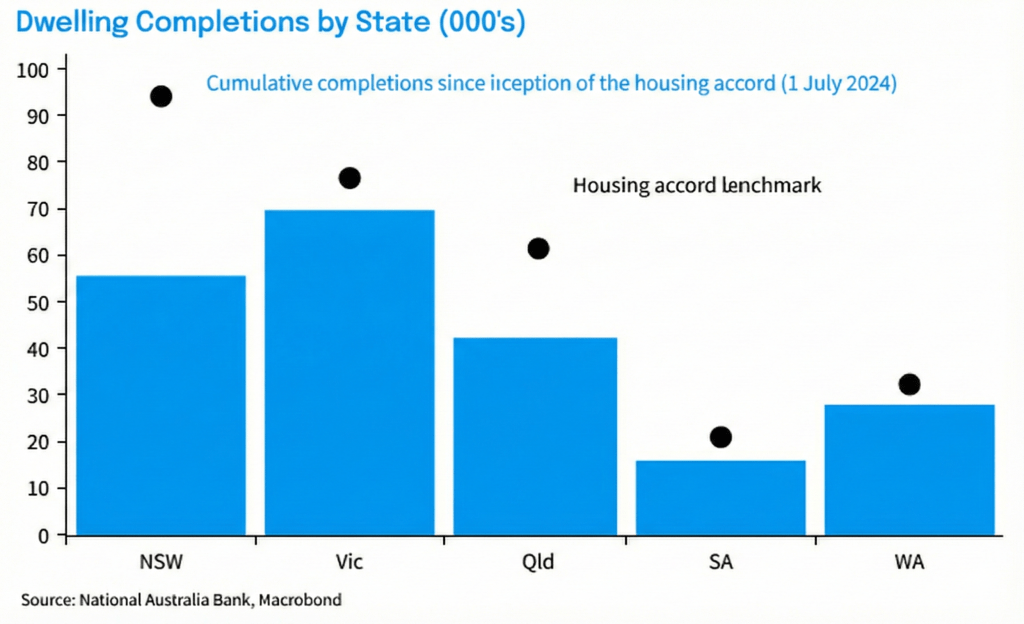
The second chart — dwelling completions by state since the start of the National Housing Accord (1 July 2024) — makes the challenge even clearer.
Across NSW, Victoria, Queensland, South Australia and Western Australia, actual completions are falling well short of the implied Housing Accord benchmarks.
- Victoria and NSW lead in absolute terms, but still trail where they need to be.
- Queensland’s completions lag population-driven demand.
- South Australia and Western Australia remain well below required run rates.
When aggregated nationally, the shortfall is significant — and cumulative.
Every quarter the gap not only persists, the backlog grows.
Demand Isn’t the Problem
This isn’t occurring in a weak economic environment.
Recent macro data reinforces that:
- The labour market remains resilient, with unemployment hovering between 4.0–4.3% for nearly two years.
- Employment growth continues to surprise on the upside.
- Household spending, while volatile month-to-month, remains solid at a quarterly level.
At the same time:
- Population growth remains structurally high.
- Rental vacancy rates are historically critically low.
- Rents continue to rise at around 5% year-on-year.
- Dwelling prices are expected to rise again this year, despite higher interest rates.
In short: demand is not going away.
Why Traditional Construction Can’t Close the Gap
From our work at Factory2Key — across traditional residential investment, Specialist Disability Accommodation (SDA), and emerging modular delivery models — we see this constraint play out in real time on projects across multiple states.
The uncomfortable truth is that Australia’s traditional construction model is no longer fit for the task it’s being asked to perform.
The current system is:
- Labour intensive
- Weather dependent
- Sequential rather than parallel
- Fragmented across trades and approvals
- Prone to cost blowouts and time overruns
Trying to solve a 2020s housing crisis with a 1960s building methodology will not work.
Pushing builders harder, offering short-term incentives, or tweaking planning rules at the margins may help — but none of these address the core constraint: delivery capacity.
The Only Scalable Solution: Changing How We Build
If Australia is serious about closing the housing gap, the solution isn’t more of the same.
It’s different.
That means changing building methodologies — specifically, shifting toward modular and factory-based construction systems.
Modern modular building allows:
- 90–95% of construction to occur in controlled factory environments
- Parallel workflows, where site works and building fabrication happen simultaneously
- Shorter, predictable build times measured in weeks, not years
- Reduced reliance on scarce on-site labour
- Consistent quality and compliance
- Lower risk of weather, trade, and sequencing delays
- Faster, better, more cost effective building methodology
Most importantly, it increases throughput — the one thing Australia desperately needs
The Conclusion: A Structural Problem Requires a Structural Fix
The data is clear.
Even with rising commencements, Australia is not building enough homes fast enough. The gap between required dwellings and completed dwellings remains large — and is still widening.
Without a fundamental shift in how homes are delivered, that gap will persist, keeping pressure on:
- Housing affordability
- Rental markets
- Cost of living
- Inflation
Incremental reform won’t close a structural shortfall.
Only a step-change in building methodology will.
Modular construction isn’t a niche solution anymore — it’s the only scalable path to delivering the volume, speed, and certainty Australia’s housing market now demands.
At Factory2Key, this belief underpins how we assess housing opportunities and delivery models. Long-term housing challenges require long-term thinking — and that means embracing modern, factory-based construction methods that can deliver certainty, scale, and outcomes the traditional system simply can’t achieve fast enough.
The question is no longer if the industry must change.
It’s how quickly it can. It MUST…
Factory2Key is a next-generation modular delivery platform created to solve the very bottlenecks highlighted in the data above.
By coordinating the entire journey — from factory-based manufacturing through approvals, logistics, site works, installation and completion — Factory2Key removes the fragmentation that slows traditional construction. With up to 90–95% of each home completed in a controlled factory environment, projects can be delivered in weeks rather than years, with greater certainty on time, cost and quality.
Factory2Key brings together the builder’s brain and the engineer’s precision to deliver predictable performance for real-world housing challenges.
Contact Factory2Key To learn more about modular delivery, modern manufacturing methods, or how Factory2Key is helping close Australia’s housing supply gap: